

Winters below zero, the Rimrocks trapping cold air in the valley below, and local refinery operations haven’t slowed anyone down. The Billings, MT, population continues climbing in 2026, and the reasons go far beyond scenery.
If you’re trying to understand who’s actually moving to Montana’s largest city and what it means for local housing, you’re asking the right question at the right time.
The short answer is that Billings is adding roughly 1% more residents every year, and most of them are landing in very specific neighborhoods. That growth is already reshaping home prices in the Heights, the West End, and Downtown.
Understanding where people are settling can help you decide whether now is the time to buy, sell, or simply pay closer attention to your own neighborhood’s value.
Billings, MT Population Growth by the Numbers
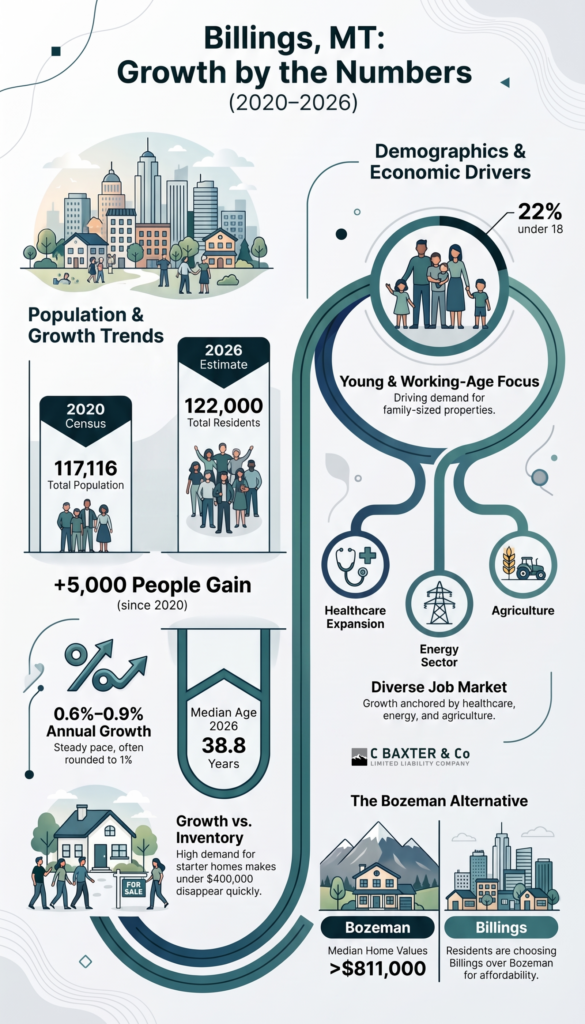
As of 2026, Billings, Montana, has approximately 122,000 residents, up from 117,116 recorded in the 2020 Census. That’s a gain of nearly 5,000 people in six years, a meaningful shift for a mid-sized Montana city.
Current Billings, MT, population growth trends fall between 0.6% and 0.9% annually, a pace many residents round up to “about 1% a year.”
Here’s what that growth looks like, broken down by the data:
- Total population (2026 estimate): ~122,000
- 2020 Census baseline: 117,116
- Annual growth rate: 0.6%–0.9%
- Median age: 38.8 years
- Population under 18: approximately 22%
- Population 65 and older: approximately 19%
Looking at Billings, MT, population by age, a clear pattern emerges. The median resident is younger than many people expect for a Montana city, leaving a solid middle band of working-age adults and young families driving demand for starter homes and family-sized properties alike.
That age spread matters for buyers. A city skewing older typically sees more downsizing and estate sales, while a city skewing younger sees more first-time buyer competition. Billings is seeing both at once, which is part of why inventory under $400,000 disappears so quickly.
Healthcare expansion at Billings Clinic and Intermountain Health St. Vincent Regional Hospital, plus steady energy and agriculture employment, keep drawing workers even when national migration slows elsewhere.
Remote workers chasing Montana’s lack of a state sales tax are part of the equation too, along with families priced out of Bozeman, where median home values have climbed past $811,000.
Where New Residents Are Landing
New arrivals aren’t spreading evenly across the city. Understanding Billings, MT, ZIP codes helps explain exactly where growth pressure is building right now:
- 59102 and 59106 (West End): Highest demand, newer construction, home values often exceeding $400,000.
- 59105 (The Heights): More affordable and family-focused, though commute bottlenecks into downtown are worsening as population grows.
- 59101 (Downtown/South Side): Historic housing stock and walkable streets. Older brick buildings can mean higher winter heating costs, but ongoing downtown revitalization and a thriving brewery district make this section highly appealing for buyers chasing a vibrant, walkable lifestyle.
Each zip code tells a different affordability story, and that’s exactly why working with someone who tracks these shifts daily matters more than scrolling listings alone.
If you’re weighing whether to buy now or wait for the next wave of arrivals, Cari Baxter can walk you through which zip codes still offer room to grow before prices catch up completely.
What Population Growth Is Doing to Home Prices in Billings, MT
Population growth and home prices move together, and Billings, MT is a clear example of that in 2026.
Median home prices climbed from roughly $350,000 to around $395,000 between early 2025 and January 2026, a direct result of more buyers chasing a limited supply of listings.
The Billings housing market outlook for 2026 suggests this pressure won’t ease anytime soon.
Inventory under $400,000 in neighborhoods like South Side and Central-Terry moves within days, not weeks. That’s a direct consequence of population growth outpacing new construction, especially in entry-level price brackets.
Is Billings, MT Still Worth the Move in 2026?
For most newcomers, yes. Whether Billings is a good place to live comes down to trade-offs. Harsh winters and refinery-driven air quality concerns sit on one side, while affordability and job stability sit on the other.
Compared to its flashier neighbor, the Billings vs. Bozeman cost of living gap remains enormous:
- Rent: Billings runs $1,141–$1,642/month vs. Bozeman’s $2,200–$2,500/month
- Median home price: Billings around $395,000 vs. Bozeman past $811,000
- Sales tax: Zero in both, since Montana has no statewide sales tax
- Job diversity: Stronger in Billings, driven by healthcare, energy, and agriculture
If you want the full monthly breakdown before deciding, the cost of living data on groceries, healthcare, and property taxes gives a realistic picture of what a household actually spends here in 2026.
Whether you’re relocating for work or trying to time a sale around this growth curve, Cari Baxter has the local data and neighborhood-level insight to help you make a confident decision instead of a guess.
You can see her current reviews and office location directly on her Google Business Profile.
💡Key Takeaways
- The Billings, MT, population has grown from 117,116 in 2020 to roughly 122,000 in 2026, a pace near 1% annually.
- Growth is concentrated in the West End and the Heights, pushing median home prices toward $395,000.
- A median age of 38.8 reflects a mix of young families and retirees competing for different housing types.
- Zip codes 59101, 59102, 59105, and 59106 each carry distinct pricing and lifestyle trade-offs worth researching before you buy.
What This Growth Means for Your Next Move
Billings isn’t exploding overnight, but steady 1% annual growth adds up fast in a city this size. Every new household landing in the West End or the Heights tightens competition for the homes already on the market.
That’s the real story behind the population numbers: fewer listings, faster sales, and less room to wait.
Whether you’re moving to Billings for the job market, the Yellowstone River access, or simply better value than Bozeman, understanding these shifts now puts you ahead of the next wave of buyers.
Ready to see how Billings, MT, population growth affects your specific price range or neighborhood? Contact Cari Baxter today for a straightforward, no-pressure conversation about your next move.
Frequently Asked Questions
Is crime high in Billings, MT?
Crime rates in Billings run above the national average in some property crime categories, though reported violent crime has trended downward in recent years.
Most incidents cluster around specific commercial corridors rather than residential neighborhoods, and areas like the West End and the Heights typically report lower rates than the downtown core.
Most residents describe day-to-day safety as comparable to other cities of similar size, with standard precautions applying.
Does Billings get a lot of snow?
Billings averages around 57 inches of snow per year, driven partly by the way the Rimrocks trap cold air in the valley below.
Sub-zero stretches in January and February are common rather than rare, though occasional Chinook winds bring temporary relief.
Anyone relocating from a milder climate should budget for higher winter heating costs and plan for regular snow removal.
What’s better, Bozeman or Billings?
The better choice depends on your budget and lifestyle priorities more than any single ranking.
Billings wins on affordability, healthcare access, and job market diversity, with median home prices around $395,000 compared to Bozeman’s $811,000 and up.
Bozeman offers stronger ski access and a livelier downtown scene, but that lifestyle carries a significantly higher price tag in 2026.
