

Home values in Billings have climbed steadily across the West End near King Avenue, through Heights neighborhoods, and into newer corridors like Ironwood and Granite Ridge.
If you bought years ago and you’re now thinking about selling, that equity growth comes with a question you need to answer before you list: how much of your profit actually goes to taxes?
In 2026, Billings homeowners who trigger a capital gains tax on a home sale will owe Montana state tax at a flat preferential rate of 3.0% or 4.1% on taxable gains (depending on their total income), plus potential federal taxes.
The good news, a powerful federal exclusion eliminates the bill entirely for most primary-residence sellers.
What Triggers a Capital Gains Tax on a Home Sale in Billings
A capital gains tax on home sale applies when your net sale proceeds exceed your adjusted cost basis what you originally paid, plus qualifying improvements and selling costs.
Not every Billings seller owes a dollar.
Your adjusted basis includes:
- Original purchase price
- Capital improvements (a finished basement in the Heights, a deck addition near Shiloh Road)
- Agent commissions and eligible closing costs
If your total gain stays within the Section 121 exclusion limits, your capital gains tax on home sale owed is $0.
Montana’s Capital Gains Tax Rate: What the Numbers Actually Look Like
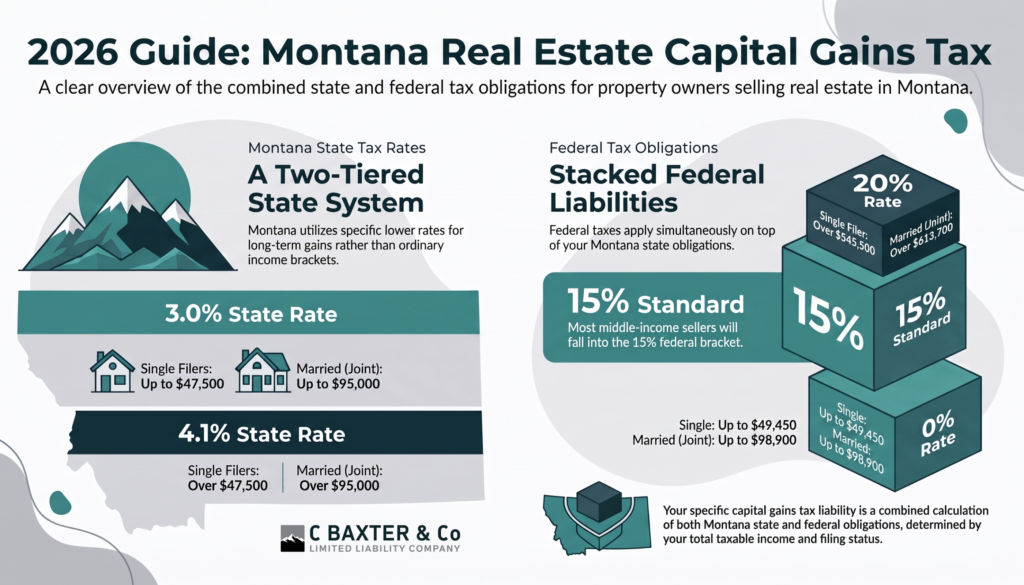
Instead of taxing real estate profits at ordinary income brackets, Montana rewards property owners by utilizing specific, lower long-term capital gains tax rates.
Under Montana’s updated tax laws for 2026, your state-level rate will be either 3.0% or 4.1%, depending directly on your overall income:
- 3.0% State Rate: Applies if your total taxable income is up to $47,500 for single filers (or up to $95,000 for married couples filing jointly).
- 4.1% State Rate: Applies to taxable income that exceeds $47,500 for single filers (or over $95,000 for married couples).
At the federal level, capital gains tax on real estate stacks on top of your state obligations. For 2026, the federal brackets are:
- 0% Federal Rate: Single filers with income up to $49,450 / Married filers up to $98,900.
- 15% Federal Rate: Most middle-income sellers (Single up to $545,500 / Married up to $613,700).
- 20% Federal Rate: High-income filers exceeding those middle-income limits.
Both rates apply simultaneously based on your total household income filing. The full capital gains tax on a home sale in Montana includes both state and federal obligations, and knowing your combined exposure before closing day is essential.
Curious what your actual net proceeds look like? Cari Baxter, a fourth-generation Montanan and Billings real estate specialist, walks sellers through real numbers before they list. Start the conversation here.
The Section 121 Exclusion: Your Most Powerful Tax Shield
The section 121 home-sale exclusion ($250k single / $500k married) protects the majority of Billings homeowners from owing any capital gains tax on home sale at all.
To qualify, the property must be your primary residence for at least 2 of the last 5 years.
Billings example: A married couple purchased a home in the Heights for $285,000 in 2016. They sold in 2026 for $530,000. Their gross gain is $245,000. The $500,000 married exclusion covers it completely zero capital gains tax on home sale owed.
If your gain exceeds the exclusion more likely for fast-appreciating Ironwood or Granite Ridge properties, only the amount above the threshold is taxed.
Running the Numbers: Using a Tax Calculator for Your Montana Sale
A capital gains tax on home sale calculator in Montana helps you estimate your actual liability before closing day. The formula:
- Sale price − selling costs = Net proceeds
- Net proceeds − adjusted basis = Capital gain
- Capital gain − Section 121 exclusion = Taxable gain
- Taxable gain × Montana rate + Federal rate = Total tax owed
Track every improvement you’ve made roof replacement, kitchen renovation, HVAC upgrade, because each one increases your basis and directly reduces your taxable gain.
For a full picture of Yellowstone County ownership costs, the Billings, MT, property tax guide breaks down assessed values and mill levy rates in detail.
Strategies to Reduce Your Montana Capital Gains Tax Bill
Legitimate options exist to minimize or eliminate your capital gains tax on a home sale:
Maximize your adjusted basis. Document every major improvement to your Billings property. A new roof, addition, or major landscaping project all increase your basis and reduce your taxable gain at sale.
Confirm your 2-year residency window. Partial exclusions are available if you’re selling due to job relocation, a health event, or unforeseen circumstances before reaching the full two-year mark.
Time your sale to a lower-income year. Selling when your total annual income is lower can drop your federal rate from 15% to 0% a significant savings on appreciated Billings properties.
Use a 1031 exchange for non-primary properties. The core strategy for avoiding capital gains tax on the sale of an investment or rental property in Montana is a 1031 like-kind exchange, which defers tax when proceeds are reinvested into another qualifying property.
Market timing matters too. Review sell now or wait for the market forecast for 2026, Billings-specific insights before setting your timeline.
Ready to understand your full net proceeds before listing? Connect with Cari Baxter for a personalized seller consultation and know exactly what you’ll keep before you sign anything.
💡Key Takeaways
- The capital gains tax on a home sale in Montana combines specific long-term state rates (3.0% or 4.1%) with federal rates of 0%, 15%, or 20% based on income.
- The Section 121 exclusion shields up to $250,000 (single) or $500,000 (married) of profit for qualifying primary-residence sellers. If your profit is under this limit, your state and federal capital gains bills drop to $0.
- Documented home improvements increase your adjusted basis, which directly lowers your taxable gain.
- Investment properties don’t qualify for Section 121 exclusions; a 1031 exchange is the primary tax-deferral strategy for landlords.
- Newer Billings neighborhoods like Ironwood and Granite Ridge carry the highest appreciation and the highest potential tax exposure.
Before You List, Know Exactly What You’ll Keep
Understanding your capital gains tax exposure on a home sale before closing is one of the most financially impactful moves a Billings homeowner can make in 2026.
From the Rimrocks-framed Heights to the growing West End near King Avenue, values have moved significantly, and your tax liability moves right along with them.
Whether you’re ready to start selling your Billings home or you want a complete walkthrough of everything selling a home in Billings involves, from pricing strategy to closing day, having a local expert who understands Yellowstone County’s market transforms guesswork into a clear, actionable number.
Don’t navigate your home sale alone. Reach out to Cari Baxter Billings, a trusted fourth-generation Montanan real estate specialist, and get clear answers before making one of the biggest financial decisions of your life.\

FAQs: Capital Gains Tax on Montana Home Sales
Do you have to pay taxes when you sell your house in Montana?
Not always. Sellers whose profit falls within the Section 121 primary-residence exclusion limits ($250,000 for single filers or $500,000 for married couples) owe zero state or federal capital gains tax on the sale.
If your profit exceeds these amounts or you are selling an investment property, you will owe tax based on Montana’s 3.0%–4.1% brackets and federal long-term gains rates.
Do I pay capital gains tax on a home sale?
You pay capital gains tax on a home sale only when your gain exceeds the Section 121 exclusion, or the property was not your primary residence.
Rental and investment properties in Billings are not subject to exclusion protection, and the full gain is subject to both Montana and federal tax rates.
How are capital gains taxed in Montana?
Montana taxes long-term capital gains using a simple, preferential two-tiered system of 3.0% and 4.1% in 2026.
The rate you pay is determined by your total taxable income, with the 4.1% rate applying only to income over $47,500 for single filers or $95,000 for married couples filing jointly.
You can review the updated bracket adjustments directly via the Montana Department of Revenue HB 337 guide.
Is there a capital gains tax on property in Montana?
Yes. Montana applies capital gains tax to all real property sales, investment properties, second homes, and vacation rentals.
Primary residences may qualify for the federal Section 121 exclusion, which is separate from Montana’s credit system and can eliminate most or all tax owed on a qualifying sale.
How do I avoid capital gains tax on my home in Montana?
Meeting the Section 121 two-year primary residency requirement is the most direct path, which excludes up to $500,000 of gain for married sellers. For investment properties, a 1031 exchange defers the tax liability.
Thoroughly documenting home improvements to increase your adjusted basis also reduces the taxable gain without requiring any special election or filing.
