
Billings sits beneath the iconic Rimrocks, those dramatic sandstone bluffs defining the city’s northern skyline, and whether you’re eyeing a craftsman in the Heights or a new build off Shiloh Road, one cost catches buyers off guard fast: property taxes.
In 2026, most Billings homeowners with qualifying primary residences pay roughly $1,200 to $2,500 per year, depending on home value and exemptions.
Understanding how the Billings, MT property tax is calculated before you close could sharpen your annual budget considerably.
How Property Taxes Are Calculated in Billings, MT
The Yellowstone County property tax system follows a three-step formula that surprises most first-time buyers:
- Market Value — Montana’s Department of Revenue appraises your home
- Taxable Value — Montana now uses a tiered assessment rate for primary residences under the Homestead Reduced Rate Program
- Mill Levy — The local mill levy in Billings is applied to your taxable value; the combined levy (city + county + school district) sits near 540–560 mills in 2026
Montana’s New Tiered Residential Tax Rates (2026)
Montana overhauled its residential property tax structure. For qualifying primary residences, the rates are:
- 0.76% on the first $378,000 of market value
- 0.90% on value above $378,000 up to a secondary threshold
- Up to 1.90% for highest-value brackets and non-primary-residence properties
Quick Example — $350,000 Primary Residence:
- Taxable Value: $350,000 × 0.76% = $2,660
- Annual Bill at 550 mills: ~$1,463
Quick Example — $500,000 Primary Residence:
- First $378,000 × 0.76% = $2,873
- Next $122,000 × 0.90% = $1,098
- Total Taxable Value: $3,971
- Annual Bill at 550 mills: ~$2,184
This tiered structure makes Billings property taxes competitive compared to high-tax states like Texas, Illinois, or Nebraska, where effective rates run significantly higher.
For a full picture of ownership costs, explore the cost of living in Billings, Montana.
Unsure what your tax bill will look like on a specific Billings home? Connect with Cari Baxter — a trusted Billings real estate expert who walks buyers through actual neighborhood-level numbers before an offer is made.
Montana Property Tax Programs Worth Knowing
Reducing your annual tax bill starts with knowing what programs you qualify for. The state offers several Montana property tax exemptions and relief programs that buyers consistently overlook.
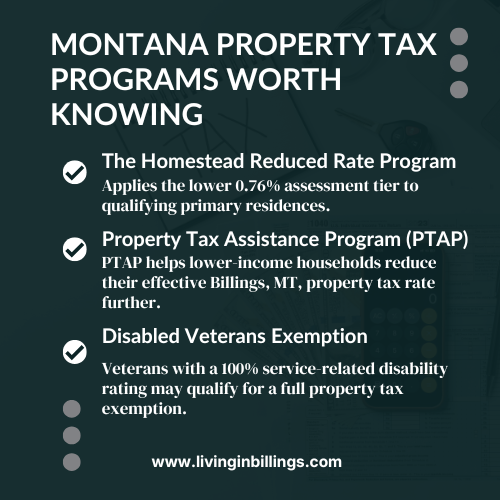
The Homestead Reduced Rate Program
The Montana homestead exemption, more accurately called the Homestead & Long-Term Rental Reduced Property Tax Rate in 2026, applies the lower 0.76% assessment tier to qualifying primary residences. To qualify:
- The home must be your primary place of residence
- You must apply through the Montana Department of Revenue
- Non-qualifying properties face rates up to 1.90% — nearly triple the base rate
This distinction has a real dollar impact. Review home buyer resources to understand which applications you’ll need before closing.
Property Tax Assistance Program (PTAP)
PTAP helps lower-income households reduce their effective Billings, MT, property tax rate further. Updated 2026 income limits are:
- Single applicants: must earn under $29,037
- Married / Head of household: must earn under $38,917
Disabled Veterans Exemption
Veterans with a 100% service-related disability rating may qualify for a full property tax exemption — one of the most generous veteran benefits in the Mountain West.
Buying in the Heights, West End, or near the Shiloh Road corridor? Property tax exposure varies by neighborhood and ownership status.
Visit Cari Baxter’s Google Business Profile for a clear-eyed breakdown before you commit.
Running the Numbers Before You Close
Before closing, use a Billings property tax calculator or contact the Yellowstone County Assessor’s office directly.
Key inputs you’ll need:
- Current appraised market value of the property
- Whether the home qualifies for the Homestead Reduced Rate
- Your school district boundary — SD2 vs. outlying districts directly affects the total mill levy
Homes in newer developments like Ironwood or Granite Ridge often carry higher initial assessed values. First-time homebuyers in Billings who run these numbers early eliminate budget surprises at closing.
What Buyers and Sellers Should Watch in 2026
Billings keeps expanding along the West End near King Avenue and out toward Shiloh Road.
As values rise, Yellowstone County property tax exposure increases even when rates stay flat.
Key factors to monitor:
- Reassessment Cycles: Montana reassesses property every two years. The 2026 cycle may push values higher in fast-growing west-side corridors, shifting some homes into a higher rate bracket
- SD2 Levy Votes: Billings School District 2 historically places levy requests on local ballots — a successful vote raises the local mill levy directly
- Investment vs. Primary Residence: Non-owner-occupied properties don’t qualify for the Homestead Reduced Rate, meaning investors face rates up to 1.90% on the same home a primary resident would tax at 0.76%
Sellers should also factor tax liability into net proceeds calculations. Browse Billings real estate listings and home seller resources for the complete picture.
Key Takeaways
- Billings, MT property tax now uses a tiered assessment rate, 0.76% on the first $378,000 for qualifying primary residences
- The local mill levy sits near 540–560 mills in 2026
- The Homestead Reduced Rate Program is critical to secure non-qualifying properties pay up to 1.90%
- PTAP income limits are $29,037 (single) and $38,917 (married), lower than many buyers assume
- Newer neighborhoods like Ironwood and Granite Ridge may see higher assessed values following the 2026 reassessment cycle
Your Next Move in Billings Starts With the Right Numbers
Understanding property taxes before you sign is one of the smartest financial moves you can make in 2026. From the Rimrocks-framed Heights to the expanding Shiloh Road corridor, Billings home values are climbing and your tax bill moves with them.
Whether you’re buying your first home or selling an established one, having a local expert who understands Yellowstone County’s tax structure turns guesswork into a real, actionable budget strategy.
Don’t navigate Billings property taxes alone. Reach out to Cari Baxter — your Billings real estate specialist who understands exactly how local property taxes impact your bottom line. Get clear answers before making one of the biggest financial decisions of your life.

FAQs about Top Billings, MT Property Tax Questions Answered
How much are property taxes in Billings, MT?
In 2026, most Billings homeowners with qualifying primary residences pay roughly $1,200 to $2,500 per year.
A $350,000 home under the Homestead Reduced Rate at 550 mills owes approximately $1,463 annually — a meaningful reduction compared to Montana’s previous flat assessment system.
Does Montana have high property taxes?
Montana’s property taxes fall in the moderate range nationally. The state’s tiered residential rates are generally favorable, especially compared to high-tax states like Texas, Illinois, or Nebraska.
Programs like PTAP and the Homestead Reduced Rate further lower the burden for qualifying residents.
What is the Montana homestead exemption?
In 2026, the relevant program is officially the Homestead & Long-Term Rental Reduced Property Tax Rate — not a traditional exemption. It applies the lower 0.76% tiered rate to qualifying primary residences, directly reducing your annual property tax liability.
Homeowners must apply through the Montana Department of Revenue and confirm the property is their primary residence to access this benefit.
